


Four days. One leather goods company. Twelve students. The work experience model that actually works.
Most work experience looks like this: shadowing someone, making tea, maybe sitting in a meeting you don’t understand. Occasionally getting to photocopy something if you’re lucky.
Our Uppingham Community College cohort spent four days at Arnold Wills & Co Ltd that looked nothing like that.
What Actually Happened
Twelve 15-year-olds arrived Monday morning. Most had never heard of Arnold Wills despite the company being 500 metres from their school. By Thursday afternoon, they were confidently networking with business professionals, presenting marketing campaigns to stakeholders, and discussing career paths they hadn’t known existed.
The difference? They weren’t observing work. They were doing it.
Monday: The Reality Check
Business consultant Rupert Turton didn’t let students dream about £150 million businesses without doing the maths. Their hypothetical ventures needed 10,000 customers for £150,000 annual profit. At realistic conversion rates of 3-6%? That’s 13.5 million leads, not the 13,500 they’d calculated.
One student’s face: “Eye-watering.”
Meanwhile, MD Philippa introduced them to a third-generation family business with 110 employees, global supply chains connecting Rutland to Spain, India, and China, and major clients including Next and Tesco.
The message was clear: successful, innovative businesses aren’t just in London. They’re in your backyard.
Tuesday: Finding Your Voice
Public speaking coach Rob Garner asked students to rate themselves 1-10. No tens. No nines. Plenty of nervous laughter.
Then he shared the biology: your fight-or-flight response hasn’t evolved in 50,000+ years. Standing in front of people triggers the same threat response as facing physical danger.
The game-changing statistic? Words are 7% of communication effectiveness. Vocal tone is 38%. Body language is 55%.
By session end, students who’d rated themselves 2-3 were standing up, making eye contact, and engaging audiences.
Wednesday: Real Challenges, Real Stakes
Marketing Manager Lucy didn’t give students a fake brief. She gave them her actual business problem: how to market Acorn & Hide to younger audiences.
“We might actually use your ideas,” she told them.
They did market research. They analysed competitors. They used AI tools for insights. And they discovered something Lucy’s team hadn’t fully appreciated: younger audiences want colourful, vibrant content, not traditional brown leather imagery.
The students became her research team for exactly the demographic she needed to reach.
Meanwhile, solicitor Rhiannon Parry—qualified just a year ago—shared the financial realities no one tells teenagers: £260,000 to raise one child in the UK. Houses in Rutland costing £200,000-300,000+. Inheritance tax at 40%.
Students who’d assumed they’d be “rich at 30” suddenly understood the actual mathematics of building wealth.
Entrepreneur Chris Ball challenged them with summer business ideas on £50 budgets. Turns out one student, Matthew, was already running a successful vintage clothing business through Vinted. Another group strategically figured out golf course car washing with a £2.50 club cleaning upsell.
These 15-year-olds instinctively understood maximising value per customer interaction.
Thursday: The Future of Work
AI specialist Tim Davies demonstrated AI tools creating music, building apps in two minutes for 22 pence, and transcribing meetings. He shared that 75% of businesses use AI, but none think they’ve deployed it correctly.
One student asked the question that silenced the room: “If I commit to a three-year degree starting now, will it actually serve me well in six years?”
Tim’s honest response: computer science degrees still have value, but only combined with practical experience. Theory alone won’t suffice in fields moving this fast.
His advice? “You have time to play—the rest of us have jobs to do. Spend 15-20 minutes daily experimenting with AI tools. You’ll be better than 95% of your peers.”
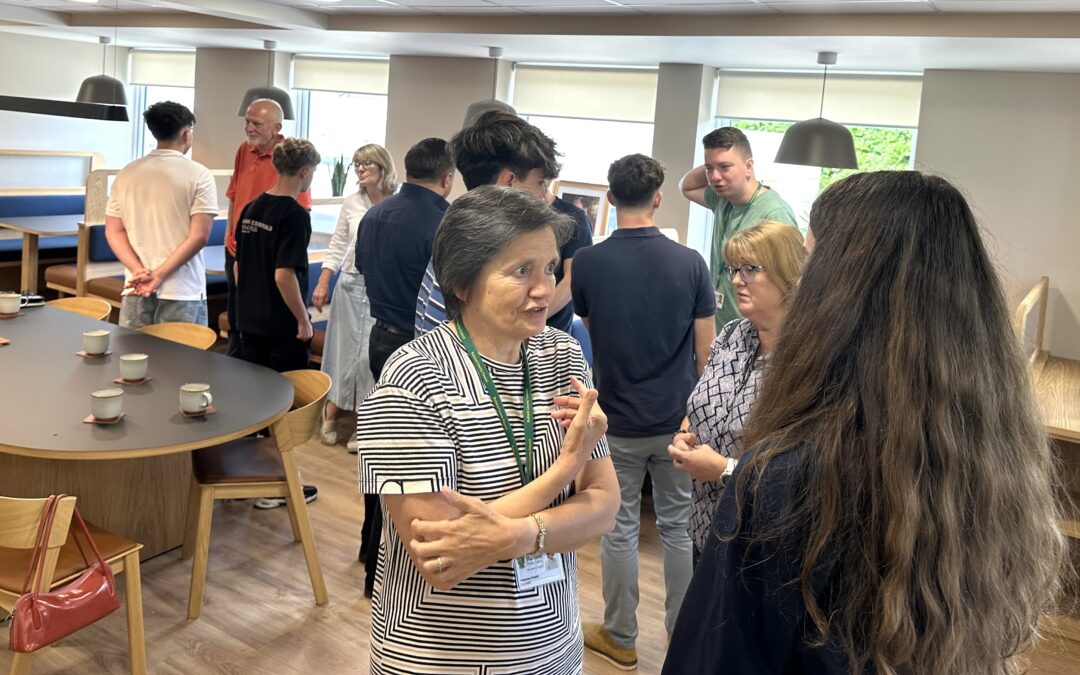
By afternoon, students were professionally networking with business leaders at an event they’d helped plan and deliver.
What Changed
Monday morning: Students arrived uncertain, many knowing only 2-3 other cohort members.
Thursday afternoon: Same students confidently networking, presenting campaigns, discussing careers with sophistication.
Not through inspiration. Through contribution.
They’d worked on genuine business challenges with real consequences. Marketing campaigns that might influence actual strategy. Networking events with real stakeholders. Financial planning with implications for life decisions.
And they’d met fourteen professionals who treated them as capable contributors, not children to be entertained.
Why This Matters
For students: They discovered successful careers exist in Rutland, learned that “jagged” career paths are normal not concerning, and built connections to professionals who remember who invested in them.
For businesses: Arnold Wills gained authentic market research from their target demographic, fresh perspectives on marketing challenges, and early relationships with potential future talent who already understand the company culture.
For community: When local businesses invest in young people, everyone benefits. Students discover local opportunities. Businesses access local talent. Knowledge transfers across generations.
The Formula That Worked
Real business challenges where students contribute genuine value, not simulated exercises designed for learning.
Professional respect from day one, using real terminology, sharing actual numbers, expecting quality output.
Tangible outcomes students can use: LinkedIn connections, presentation techniques, business analysis frameworks, professional relationships.
Diverse perspectives across multiple professionals, so students see that successful careers follow many paths.
That’s work experience that actually works.
The Business Hub Work Experience CIC creates authentic partnerships between businesses and young people, delivering genuine value to both.
We don’t facilitate observation. We architect transformation.
Want to know more? Get in touch: nicola@bizhubworkexp.co.uk | 07432 766001